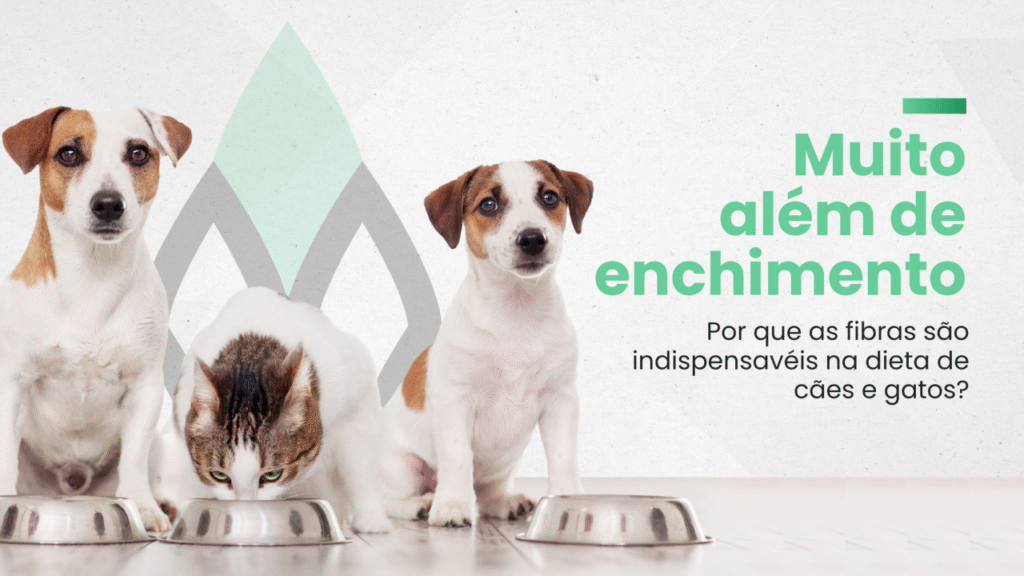
Dog and cat nutrition has evolved significantly in recent decades. One component that has been gaining prominence is dietary fiber. Once seen as mere filler in pet food, fiber is now known to play an essential role in digestion, gut health and even in managing conditions such as obesity and diabetes.
But how does fiber really work in pets’ bodies? What are the best types for each situation, and what are the risks of too much in the diet? To answer these questions, O Presente Pet spoke with Luciano Andriguetto, a veterinarian and professor at the Federal University of Paraná (UFPR) who specializes in animal nutrition. Andriguetto clarifies the main concepts of fiber in dog and cat feeding, covers its functions and benefits, and comments on the latest innovations in diet formulation.
O Presente Pet – What is the concept and importance of fiber in dog and cat nutrition, and how does it influence the animals’ digestion and gut health?
Luciano Andriguetto – From a functional standpoint, dietary fiber is any carbohydrate that is not digested and reaches the large intestine, where it can be fermented and serve as a substrate for the growth of the gut microbiota. Fiber in the diet acts at several points. First, it lowers the nutritional density of the diet, increasing the volume of food eaten without adding nutrients, so total nutrient intake can be reduced. Second, fiber can affect intestinal transit, usually regulating it, though it can either speed it up or slow it down depending on the type of fiber. Third, fiber is usually a determinant of the gut microbiota, which can be more or less healthy depending on the quantity and quality of the fiber. Dogs and cats have somewhat different digestive systems, and the cat, as a more specialized carnivore, is less “equipped” to handle some types of fiber in the diet. It is worth stressing that fiber exists only in foods of plant origin.
O Presente Pet – What are the main types of fiber and their functions?
Luciano Andriguetto – Fibers are classified as soluble and insoluble, but both are fermentable. Soluble fibers are usually fermented faster, with fermentation peaking within two hours of ingestion. Some soluble fibers also increase the viscosity of the digesta by forming a gel with water. This is an undesirable trait, because viscosity reduces enzyme activity and therefore digestibility, and it can also cause intestinal discomfort by forming foam and trapping gas.
Insoluble fibers usually ferment more slowly, taking 6 to 18 hours to reach peak fermentation. In animals with a small large intestine, such as dogs and cats, fiber transit time is relatively short, which limits fermentation of insoluble fiber. Even so, all types of fiber are substrates for the gut microbiota, and the right combination of fiber types is what maintains a stable, healthy microbiota.
O Presente Pet – What are the clinical benefits and practical uses of high-fiber diets? Are there risks of too much fiber in the diet?
Luciano Andriguetto – The main benefit of high-fiber diets is gut health. A stable, healthy microbiota is the best way to keep intestinal pathogens out, preventing diarrhea and enteritis. Another benefit is diluting diets, which allows better control of energy intake. Filling the digestive tract with bulky material sends a satiety signal. In addition, insoluble fibers hold water, increasing their volume and the feeling of fullness. The production of short-chain fatty acids from fiber fermentation in the large intestine also contributes to satiety, since these acids are absorbed and metabolized. For this reason, fiber in dog and cat diets is indicated in a number of situations, mainly related to weight control and intestinal problems such as chronic enteritis.
Dietary fibers also help control diabetes, as they tend to slow glucose absorption and so lower the glycemic index of the diet. This also leads to a longer feeling of fullness because the insulin spike common in low-fiber diets does not occur. As for excess fiber, major problems are not expected, but it is important to watch for excessive weight loss if the animal cannot eat all the energy it needs. There may also be excessive gas production, causing abdominal discomfort and pain, along with larger stool volume. Excess fiber can also interfere with the absorption of some minerals, which may lead to loss of performance.
O Presente Pet – What are the recommended fiber levels for formulating commercial diets and natural or homemade diets?
Luciano Andriguetto – Recommendations for fiber level or inclusion of fibrous ingredients vary widely in the literature. Dogs and cats tolerate low-fiber diets well, but they also adapt to, and benefit from, total dietary fiber levels above 5% of the feed. Ingredient inclusion will therefore depend on the expected result and the indication for the diet, and can generally range from 1 to 6%.
Natural and homemade diets can meet fiber needs through plant ingredients (remembering that resistant starch also behaves like fiber). But it is important to watch quantities, if only so that other nutrients, such as protein, do not run short. Stool volume and consistency are usually a good indicator of the fiber content and quality of the diet, but ideally owners should always seek professional guidance when formulating homemade diets.
O Presente Pet – Is there any research, new technology or innovation in the use of fiber in pet nutrition?
Luciano Andriguetto – We keep learning more about the different fibrous ingredients and their effects in pet food. It is also important to know not only the effect on the animals, but also on the manufacturing process. The type and level of fiber can affect equipment throughput and kibble quality, including its softness, durability and water-holding capacity. An ingredient considered a quality benchmark as a fiber source is beet pulp, which is rich in soluble fiber but does not cause viscosity. Unfortunately, Brazil does not produce this pulp, a by-product of beet sugar manufacturing, which makes it expensive.
But we have other fibrous ingredients that can replace it with advantages. Micronized, pressed lignocellulose is an excellent source of insoluble fiber. For pet food, it is combined with cassava fiber. This comes from the extraction of cassava starch. It is free of husk and of any antinutritional factor, and is widely used in human food. Recent research has shown that combining these two ingredients creates a fiber-rich compound, balanced in soluble and insoluble fractions, with excellent performance both in the animals and in manufacturing, and that replaces beet pulp.
O Presente Pet – What is the main message you would leave for veterinarians, animal scientists and owners about the importance of fiber in pet nutrition?
Luciano Andriguetto – Far from being “cheap filler” in pet foods, fibrous ingredients are now excellent tools for managing pet health, both preventively and as support for therapy in diseases such as chronic enteritis, diabetes, obesity and others. Not all fibers are the same, and choosing the right fiber source is essential to get the desired result. Professional guidance should always be sought when choosing ingredients and the most suitable feeds and treats for each case.
Prof. Luciano Andriguetto
Professor at the Federal University of Paraná.
Courses: Animal Nutrition and Applied Animal Nutrition for the Veterinary Medicine and Animal Science programs.