Additive to optimize calcium and phosphorus absorption in sow and piglet diets
Authors: José L. Andriguetto¹, Luiz R. Alberton², Geraldo C. Alberton¹, Daiane G. Donin¹ – UFPR; ² – BSSUI Pesquisa e Consultoria em Suinocultura
INTRODUCTION
Among the benefits feed additives can offer pigs at the different production stages, optimized nutrient absorption and better gut health are certainly the most significant, since they directly affect feed efficiency, disease reduction and animal performance. Several feed additives have been tested to optimize the absorption of nutrients, including calcium (Ca) and phosphorus (P), in both sows and their litters. Both elements are central to milk production and piglet development, and maximizing their absorption offers great potential return. The objective of this study was therefore to evaluate the effect of an additive, a long-chain fatty acid polyol with emulsifying and Ca and P carrier action, on the performance of lactating sows and their litters through to the end of the nursery.
MATERIALS AND METHODS
From 75 days of gestation, 46 Cambrough sows were selected by parity, body condition score and productivity, and divided into two treatments. Suckling piglets were weaned at 24 days of age, individually identified and weighed, separated by sex and distributed among treatments by live weight. After weaning, at 24 days postpartum, 40 sows were followed for performance data. Piglets were allocated to four treatments with 12 replicates, each replicate being a pen of 10 piglets, for a total of 480 animals. The distribution kept each piglet matched to its sow’s treatment. T2 and T3 differed only in the phase 4 diet (Table 1). In sows, body condition score was evaluated at breeding, pre-farrowing, after farrowing and after weaning, along with health data, total born, born alive, birth weight, mortality rate, culling rate, individual and litter initial/final weight, feed intake of sows and piglets, sow feed conversion, piglet feed conversion, weaning-to-estrus interval (WEI), insemination rate and pregnancy rate. In nursery piglets, weight at the end of each phase (4 phases in total), time (days) to consumption per phase, feed conversion per phase and for the whole nursery, intake per phase and for the whole nursery, and batch health data were evaluated. Minitab 19 software was used. Data were subjected to Grubbs’ test to identify outliers, and a GLM (Generalized Linear Model) was then applied for inferential analysis at a 5% significance level.
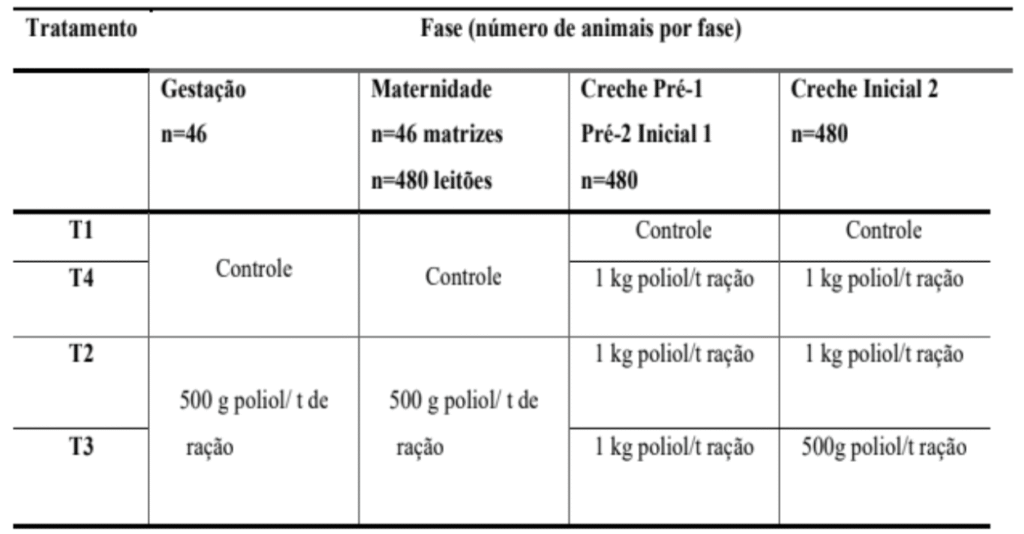
of animals subjected to each treatment.
RESULTS AND DISCUSSION
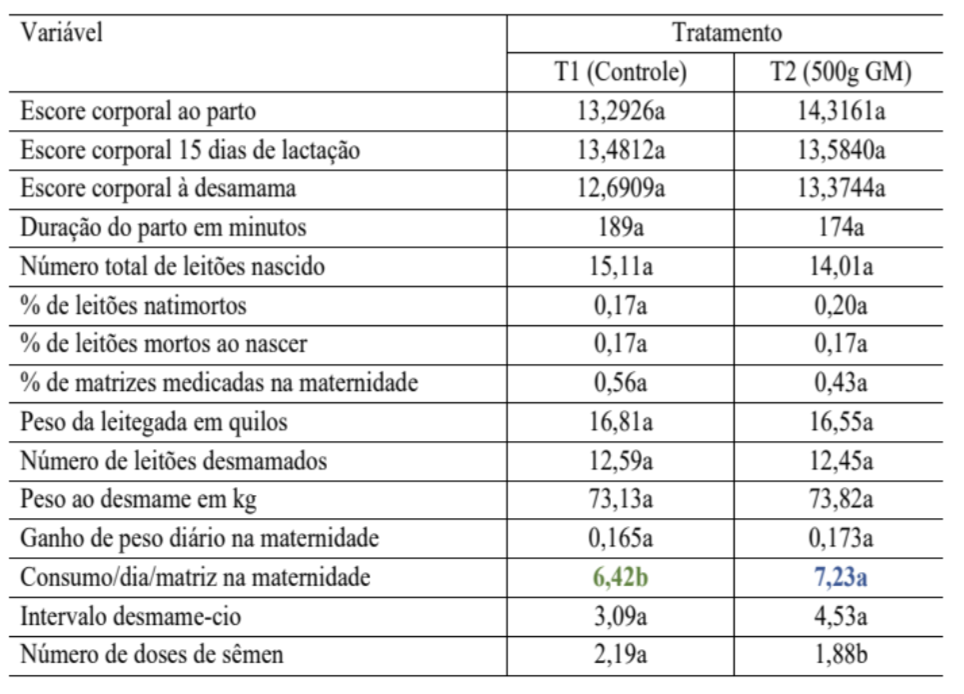
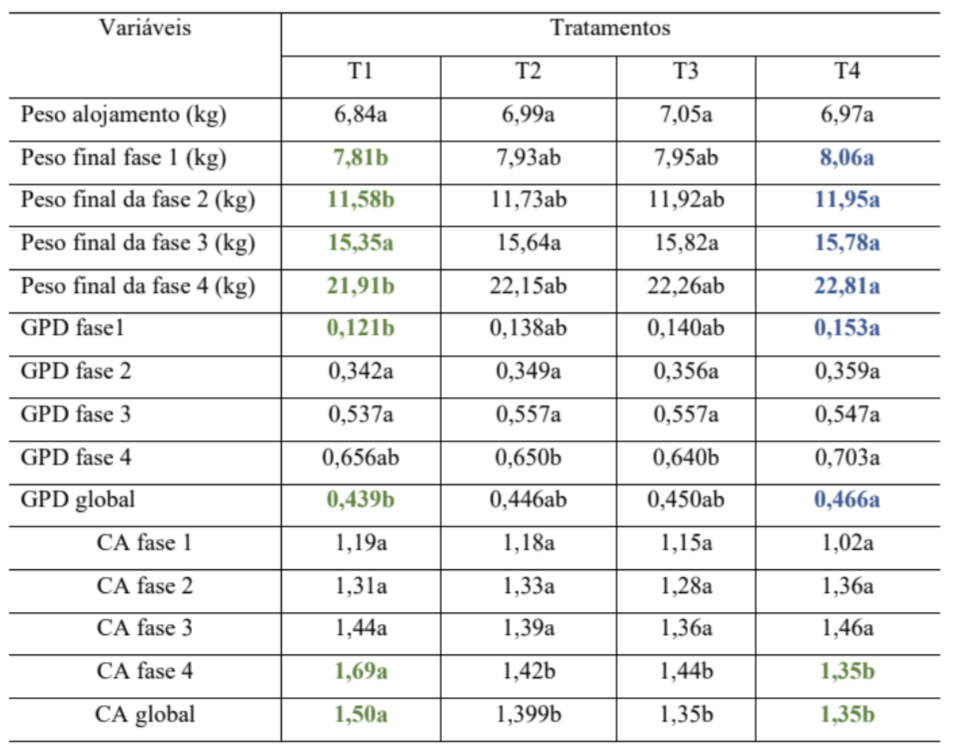
Use of the polyol during gestation and farrowing did not affect sow and piglet performance (Table 2). However, supplemented sows ate more feed in the farrowing phase (p<0.05), had a higher body condition score and a shorter estrus, and therefore received fewer semen doses (p<0.05). The lack of productivity results is probably because Ca and P absorbed beyond requirements are directed to bone (Floradin et al., 2022). There was no residual effect of sow supplementation on piglet performance. On the other hand, polyol supplementation in the nursery phase improved feed conversion ratio (FCR) and average daily gain (ADG) (Table 3). Group T4 (offspring of control sows; 1 kg of additive/ton throughout the nursery) was the only group that differed statistically from the control group in ADG (p<0.05), as groups T2 and T3 showed intermediate performance. Feed conversion in all treated groups was better (p<0.05) than in the control group. Superior performance of piglets fed phosphorus levels above requirement was also observed by Wu et al. (2019), who suggest that the requirement in this phase is underestimated. It was also observed that the 1 kg/ton dose in phase 4 of the nursery diet is excessive, since the group that received half the dose in phase 4 performed the same as those that received the full dose. Saraiva et al. (2009) showed that piglets above 15 kg perform worse when dietary phosphorus becomes excessive, suggesting that in phase 4 the phosphorus level of the polyol-supplemented diet could be reduced.
CONCLUSIONS
In diets with adequate Ca and P content, the additive does not affect sow performance in gestation and farrowing. These results suggest that, with the polyol, it may be possible to reduce the Ca and P content of these diets. In diets with adequate P content, the polyol positively affects ADG and feed conversion of piglets in the nursery phase, showing potential to optimize the piglet start.
REFERENCES
Floradin P.; Létourneau-Montminy, M.P.; Pomar, C.; Schlegel, P. Development of bone mineralization and body composition of replacement gilts fed a calcium and phosphorus depletion and repletion strategy. Animal, 16. 2022
Saraiva, A.; Donzele, J.L.; Oliveira, R.; Abreu, M.; Silva, F.; Santos, F. Available phosphorus levels in diets for swine from 15 to 30 kg genetically selected for meat deposition. Revista Brasileira de Zootecnia, v.38, n.2, p.307-313, 2009
Wu, F.; Woodworth, J.C.; Tokach, M.D.; Dritz, S.S.; DeRouchey, J.M.; Goodband, R.D.; Bergstrom, J.R. Standardized total tract digestible phosphorus requirement of 6 to 13 kg pigs fed diets without or with phytase. Animal, 13:11, pp 2473–2482. 2019